I am learning flutter from JustAcademy, They provide very much great environment where people gather and work simultaneously. totally project based training institute.
MOHD ABU BAKAR ANSARI
Flutter Developer
Awesome Experience. I am a Front-end Web Designer working at Star India for 3 years now. I applied for Full-stack development and my experience has been phenomenal & they really do help with placements exceptionally. Thank you Roshan sir so much.
A practical, Mumbai rooted comparison for anyone trying to pick the right mobile development path this year
Why Mobile App Development Is Still One of India's Most In-Demand Careers
Every few months someone declares that app development is "saturated" or that the market has cooled down, and every few months the numbers prove otherwise. India now has one of the largest smartphone user bases in the world, and businesses across banking, healthcare, ecommerce, food delivery and education are still racing to build or rebuild their mobile presence. That race needs people who can actually write the code behind the apps we use every single day, and that is exactly why mobile application development continues to be one of the most stable entry points into a long term tech career.
What has changed, though, is the number of ways to enter this field. A decade ago your only real choice was to learn native Android with Java or native iOS with Objective C. Today you can build for both platforms at once using Flutter or React Native, or you can still go the native route if you want deeper control and platform specific performance. This flexibility is wonderful, but it also creates confusion. Should you learn Flutter first? Is React Native still relevant in 2026? Does native development pay more? Is one of these frameworks going to become obsolete? If you would rather explore these questions in a live classroom setting than through another article, you can always book a free demo class and ask a working instructor directly.
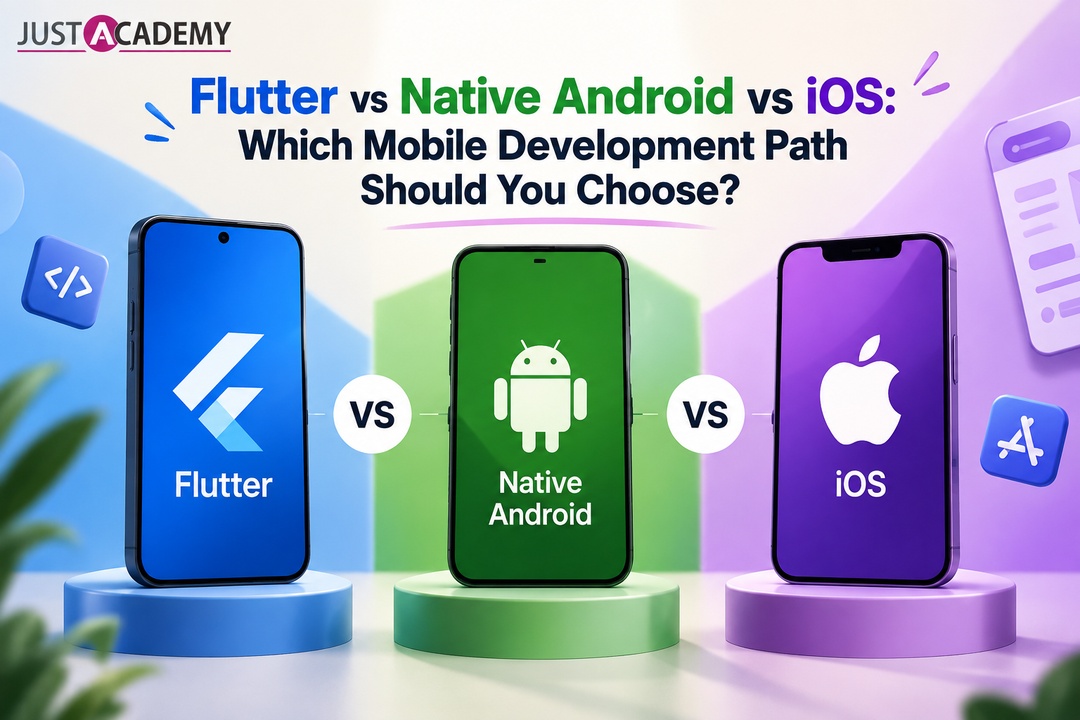
This blog is written to answer those exact questions honestly, without picking a winner just to sound decisive. Each of these four paths, flutter app development, react native app development, android app development and ios app development, has genuine strengths, and the right choice depends on your background, your goals and even the kind of companies you want to work for.
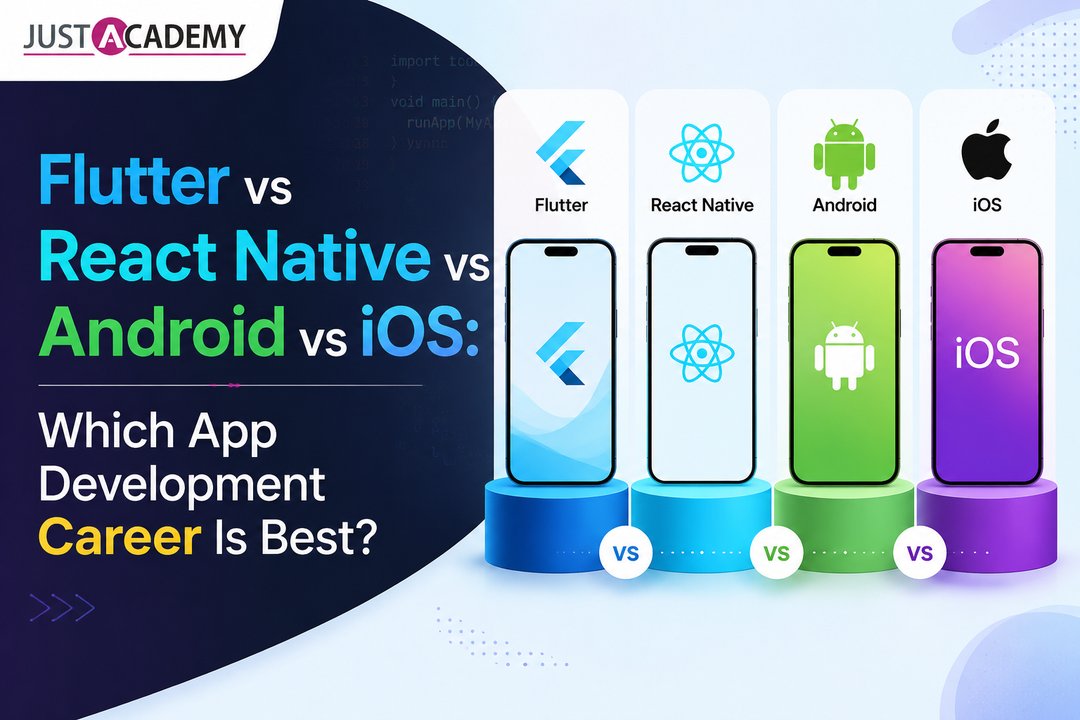
Understanding the Four Paths: Flutter, React Native, Android and iOS
Before comparing salaries or job openings, it helps to actually understand what each of these technologies is doing under the hood. A lot of career confusion comes from treating them as interchangeable options when they solve problems in fundamentally different ways.
What Is Flutter and How Does It Work
Flutter is Google's open source framework for building natively compiled applications for mobile, web and desktop from a single codebase. It uses a language called Dart, which was also created by Google, and it renders every single pixel on the screen itself instead of relying on native platform components. That is a big part of why Flutter apps tend to look and feel identical on both Android and iOS, and why animations often feel smoother compared to other cross platform tools. If this sounds like the kind of hands on, visually driven work you enjoy, you can explore the complete curriculum through this Flutter training program, which covers Dart fundamentals right through to publishing a real app.
Flutter has grown rapidly because a single Dart codebase can ship to both app stores, which cuts development time significantly for startups and agencies working on tight budgets. If you want a deeper read on where Flutter stands specifically for the Mumbai job market, this breakdown of whether Flutter is worth learning in 2026 is worth going through separately.
What Is React Native and Why Do Companies Choose It
React Native, built by Meta, takes a slightly different approach. Instead of drawing its own pixels, it uses JavaScript and React to control real native components on each platform, which means a React Native button is an actual native Android or iOS button underneath, not a redrawn imitation of one. This matters to companies that already have a web team comfortable with React, because the learning curve for those developers to pick up React Native is much shorter than starting a brand new language from scratch.
Large scale apps you have almost certainly used, including parts of Instagram, Discord and Shopify, rely on React Native for at least some of their mobile experience. That kind of adoption keeps job demand steady, and it is one of the reasons React Native app development remains a strong long term skill rather than a passing trend.
Native Android Development Explained
Native Android development means writing code specifically for Android using Kotlin, which has now fully replaced Java as Google's recommended language for new Android projects. Because you are working directly with Android's own tools, APIs and hardware features, native apps generally offer the best possible performance, the smoothest access to device sensors and cameras, and the fastest adoption of new Android features the moment Google releases them. If your long term goal is to work at a company that treats its Android app as a core product, not a side project, this android app development path gives you that depth.
Native iOS Development Explained
iOS development follows the same philosophy but on Apple's side, using Swift as the primary language along with Xcode as the development environment. Apple's ecosystem is known for strict design guidelines, tight hardware and software integration, and users who are generally willing to pay more for quality apps, which is why iOS development is often associated with premium products, fintech apps and companies with strong revenue per user. If you are drawn to that ecosystem specifically, a focused ios training course will take you through Swift, UIKit or SwiftUI, and the full app store submission process.
Flutter vs React Native: The Cross Platform Battle
Since Flutter and React Native are solving the same core problem, one codebase for two platforms, they get compared to each other constantly, and honestly the comparison is fair because they genuinely compete for the same projects and often the same job openings.
Performance and Development Speed
Flutter tends to win on raw animation performance because it renders directly to the screen rather than passing through a JavaScript bridge, which historically was React Native's biggest performance bottleneck. Meta has significantly improved this with its newer architecture, narrowing the gap considerably, but Flutter still holds a slight edge for apps with heavy custom animations or games. On the flip side, React Native usually wins on initial development speed if your team already knows JavaScript, because there is no new language to learn, just a new way of using the one you already have.
Community Support and Job Availability
Both frameworks have massive communities, extensive documentation and a huge library ecosystem, so neither is going to disappear overnight. Job availability tends to shift slightly by region and by industry. Startups building consumer facing apps with heavy visual identity often lean toward Flutter, while companies with existing web platforms and JavaScript heavy teams often lean toward React Native. If your interest leans this direction, a structured react native training course paired with some real project work, like the concepts covered in this React Native beginner course guide, gives you a genuinely practical starting point rather than just theory.
Native Android vs Native iOS: Choosing a Single Platform Path
If cross platform development does not appeal to you and you would rather go deep on one ecosystem, the choice between Android and iOS comes down to a mix of personal interest, target market and long term specialization.
Learning Curve for Android
Kotlin is a modern, concise language that many developers find friendlier than older Java syntax, and Android Studio, while resource heavy, offers excellent tools for debugging and layout design. Because Android holds a dominant share of the smartphone market in India and much of Asia, native Android developers are consistently in demand from companies building for these regions specifically, including fintech, edtech and logistics apps.
Learning Curve for iOS
Swift is widely regarded as one of the more approachable modern languages, with clean syntax and strong safety features that catch errors before they happen. The learning curve is less about the language itself and more about becoming familiar with Apple's design conventions and the Xcode environment, which some developers find restrictive and others find refreshingly organized. Companies targeting global markets, particularly in the US, UK and parts of Europe where iOS usage is proportionally higher, actively seek native iOS talent, often at a premium.
Salary Comparison Across Flutter, React Native, Android and iOS Developers in India
Salary is usually the question people actually want answered, so let us look at it directly. These figures reflect general market patterns across Indian tech hubs including Mumbai, Pune, Bangalore and Hyderabad, and naturally vary based on company size, city and individual skill depth.
Role
Entry Level (0 to 1 yr)
Mid Level (2 to 4 yrs)
Key Growth Driver
Flutter Developer
3.5 to 5.5 LPA
6 to 12 LPA
Custom UI, animation and Dart depth
React Native Developer
3.5 to 5.5 LPA
6 to 12 LPA
Existing JavaScript and React skills
Android Developer (Kotlin)
4 to 6 LPA
7 to 14 LPA
Native performance and Jetpack expertise
iOS Developer (Swift)
4.5 to 6.5 LPA
8 to 16 LPA
Apple ecosystem and premium app clients
Entry Level Salaries
At the entry level, the four paths are closer together than most people expect. What actually separates candidates at this stage is not which framework they chose, but how many real projects they can show, how well they understand fundamentals like state management and API integration, and whether they received any placement support during their training to actually get in front of the right recruiters.
Salaries After Two to Three Years of Experience
The gap widens with experience, particularly for native iOS and native Android developers, since fewer engineers reach genuine mastery of these ecosystems compared to the larger pool of cross platform developers. That said, an experienced Flutter or React Native developer who has shipped multiple production apps, understands performance optimization and can work independently often commands salaries that match or exceed native developers, especially at startups that value shipping speed.
Job Opportunities and Career Growth in Mumbai and Beyond
Mumbai's tech and startup ecosystem has grown considerably, with fintech, edtech, healthtech and D2C ecommerce brands consistently hiring mobile developers across all four skill sets. Beyond Mumbai, Pune's IT corridor and the broader national market offer even more depth, particularly for consulting firms and product companies serving global clients.
Startups vs Enterprises: Where Each Skill Fits
Early stage startups with limited budgets frequently prefer Flutter or React Native because a single team can maintain both platforms, which keeps hiring costs down. Larger enterprises and companies with performance critical apps, such as banking or gaming platforms, are more likely to maintain separate native Android and native iOS teams, since the additional cost is justified by the performance and stability requirements.
Remote and Global Opportunities for App Developers
Mobile development remains one of the more remote friendly specializations in tech, and Indian developers regularly work with international teams and clients. This is where JavaScript proficiency becomes particularly valuable, since it opens doors beyond mobile alone. Developers who pair app development with strong javascript training often find themselves qualified for broader full stack roles too, which naturally increases the number of jobs they can apply for.
If you are already thinking beyond a single specialization, it is worth knowing that full stack paths pair extremely well with mobile skills. A program like the MERN stack developer bootcamp can complement a React Native background particularly well, since both share the same JavaScript foundation, letting you move fluidly between web and mobile projects depending on what a client or employer needs.
Thinking about which direction fits your goals best? You can register for a free demo class to experience the teaching style before committing to a full course.
Which Skill Should You Learn First? A Practical Roadmap
There is no single correct answer here, but there is a genuinely useful way to think about it based on where you are starting from.
If You Are a Complete Beginner
If you have no prior programming background, Flutter is often the gentler starting point because Dart's syntax is clean, the documentation is beginner friendly, and you get visual, tangible results very quickly, which keeps motivation high during the early weeks of learning. Seeing a working app on your own phone within the first few sessions makes a real difference when you are just starting out.
If You Already Know JavaScript or Java
If you already have some JavaScript experience from web development, React Native will feel far more natural since you are reusing concepts like components, state and props rather than learning them from zero. Similarly, if you have a Java background, native Android with Kotlin will feel like a logical next step rather than a completely new mountain to climb, since a lot of the object oriented thinking carries over directly.
Why Structured Training Makes the Difference
Reading documentation and watching scattered tutorials can teach you syntax, but it rarely teaches you how to structure a real app, debug production issues, or actually get hired. This is where structured, mentor led learning changes the outcome, and it is exactly what JustAcademy has built its programs around.
As an ISO certified training institute with physical branches in Mumbai and Pune and live interactive sessions available to learners anywhere in the world, JustAcademy focuses on project based learning rather than passive video watching. Every course, whether Flutter, React Native, native Android or native iOS, is taught by instructors with real industry experience, in small batches where questions actually get answered rather than lost in a comment section. Because the sessions are live and interactive, you get immediate feedback on your code, which shortens the gap between confusion and understanding significantly.
Placement support is built into the structure too, not offered as an afterthought. Learners get help with resume building, mock interviews and introductions to hiring partners, which matters enormously in a field where technical skill alone is often not enough to land the first job. Whether you are choosing Mumbai classroom training for the in person mentorship or the global live interactive online option for flexibility, the underlying goal stays the same: turning a beginner into someone genuinely ready for a professional app development role, not just someone who has completed a course.
Conclusion
Flutter, React Native, native Android and native iOS are not rivals competing for a single winner, they are four legitimate doors into the same growing industry. Flutter and React Native offer speed and cross platform efficiency, ideal if you want to build for both app stores without doubling your workload. Native Android and native iOS offer deeper platform mastery and often higher ceilings for experienced developers, particularly for performance sensitive or premium products. The best course in Mumbai for you is simply the one that matches how you learn and where you want to end up, and the good news is that with the right structured, live interactive training, any of these four paths can lead to a genuinely strong app development career in 2026 and beyond.
If you are ready to take the next step, register for a free demo class to see how the training actually works, or download the complete course brochure to compare every program in detail before you decide.
Understanding the Four Paths: Flutter, React Native, Android and iOS
Salary Comparison Across Flutter, React Native, Android and iOS Developers in India
Job Opportunities and Career Growth in Mumbai and Beyond
Which Skill Should You Learn First? A Practical Roadmap
A practical, no fluff guide to what it actually takes to build a career as a PHP Laravel developer, written for learners in Pune who want a real answer, not a recycled one.
A practical comparison for Pune based learners choosing between MERN and Java full stack development, covering salary, learning curve, job roles, and long term career growth.